SPLM-IO Rejects Decision to Amend Peace Deal, Citing Exclusion of Dr. Riek Machar
Juba, South Sudan — The Sudan People’s Liberation Movement-in-Opposition (SPLM-IO) faction loyal to suspended First Vice President Dr. Riek Machar has rejected a presidency decision to proceed with national elections by December 2026, describing the process as illegitimate, non-inclusive, and a violation of the 2018 Revitalized Agreement on the Resolution of the Conflict in South Sudan (R-ARCSS).
The decision followed a high-level meeting chaired by President Salva Kiir and attended by the country’s vice presidents and some signatories to the peace agreement. The meeting resolved to amend parts of the revitalized agreement to allow elections to take place within the proposed timeline, while deferring the implementation of key reforms until after the polls.
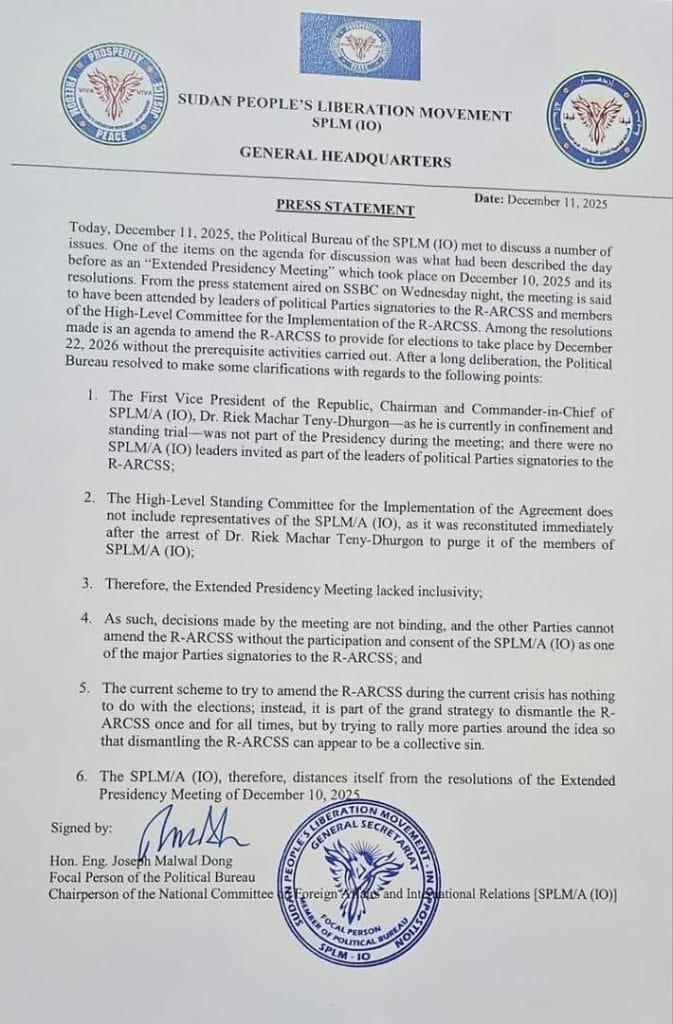
However, in a strongly worded statement, the SPLM-IO faction aligned with Dr. Machar said the meeting lacked legitimacy due to the exclusion of its chairman, who remains under house arrest in Juba. The group emphasized that no representatives of the mainstream SPLM-IO were invited or consulted, rendering the resolutions invalid.
“The SPLM-IO rejects the decisions taken in the absence of its leadership and participation,” the statement read, adding that any amendment to the peace agreement without the consent of all principal parties constitutes a breach of the deal.
The faction also objected to the reconstitution of the High-Level Standing Committee, arguing that the move effectively sidelined the SPLM-IO by denying it representation in a key oversight body responsible for guiding the implementation of the peace agreement.
According to the statement, critical provisions of the 2018 agreement remain unimplemented, including permanent security arrangements, the constitution-making process, a national population census, and wide-ranging institutional reforms. The group warned that pushing for elections without addressing these foundational issues risks undermining the credibility of the electoral process and the fragile peace.
The SPLM-IO formally distanced itself from the resolutions adopted at the meeting and reiterated its commitment to the full and faithful implementation of the revitalized peace agreement as the only viable path toward sustainable peace and democratic transition in South Sudan.
The rejection of the presidency’s decision by Machar’s SPLM-IO highlights deepening fractures within South Sudan’s transitional framework and raises serious questions about the feasibility of elections in 2026.
At the heart of the dispute is inclusivity — a core principle of the 2018 peace agreement. Any attempt to amend the deal without the participation of one of its principal signatories risks unraveling the already fragile consensus that ended years of civil war. The continued house arrest of Dr. Riek Machar further complicates the political environment, reinforcing perceptions of unilateralism and political exclusion.
More fundamentally, the standoff underscores a long-standing dilemma: whether elections can credibly take place without completing key reforms such as security sector unification, constitution-making, and a national census. By prioritizing election timelines over these benchmarks, the government risks holding polls that lack legitimacy and public confidence.
Unless trust is rebuilt and all parties are brought back to the table, South Sudan’s transition may once again drift into uncertainty — with potentially serious implications for peace, stability, and regional confidence in the process.